
Straight Spool Piece
For example, a pipe section with prepared ends, flanges, couplings or other drawing-defined connections can bridge two known interfaces.
A stainless steel spool piece from Mesta Inc. is manufactured to approved drawings, piping classes and project specifications. Therefore, buyers can define the exact grade, end connections, dimensions, weld controls, inspection scope and surface condition for each identified piece.
A stainless steel spool piece is one drawing-defined section of a piping system. It can combine straight pipe with elbows, tees, reducers, flanges, branches, couplings or approved attachments. A unique spool number links the finished component to its drawing, materials, welds and inspection records.
Unlike a loose pipe length, the piece arrives with specified geometry and end preparations for its installation position. Consequently, the project can complete controlled cutting, fit-up, welding and inspection before work reaches the site.
In addition, this page focuses on an individual stainless component, including a replacement piece. For complete multi-piece fabrication packages, visit stainless steel pipe spools. For a material-neutral explanation, see our pipe spool piece page.
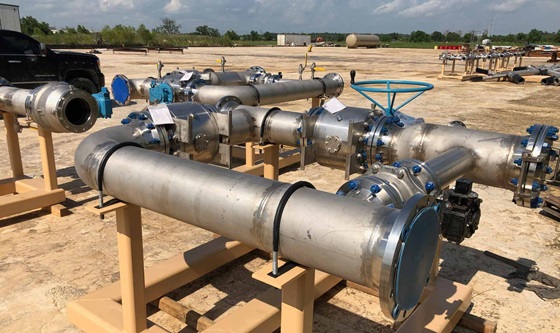
The drawing determines the geometry; the keyword does not. For example, a stainless spool piece may be straight, flanged, offset, branched or designed for removal. The following configurations address different installation needs.
For example, a pipe section with prepared ends, flanges, couplings or other drawing-defined connections can bridge two known interfaces.
One or more flanges provide bolted interfaces. However, the drawing must control facing, class, bore, alignment and bolt-hole orientation.
Meanwhile, direction changes may combine elbows and straight lengths while preserving centre-to-face and overall dimensions.
Similarly, concentric or eccentric reducers connect different line sizes according to the required orientation and flow arrangement.
In addition, tees, outlets or fabricated branches introduce connections that may require branch-specific examination.
Finally, flanged or otherwise detachable sections can support equipment access, maintenance or future isolation requirements.
Explore flanged pipe spools, elbow spools and removable spool pieces for configuration-specific guidance.
The project piping material specification must select the grade from the actual process and design conditions. In particular, fluid chemistry, chlorides, temperature, pressure, cleaning chemicals, crevices and fabrication requirements can affect material suitability.
| Grade family | General characteristics | Project considerations |
|---|---|---|
| 304 / 304L | For example, these common austenitic grades suit many general process and utility applications; the low-carbon grade supports welded-fabrication strategies. | Media chemistry, chloride exposure, temperature, cleaning method and post-weld condition |
| 316 / 316L | In comparison, these molybdenum-bearing austenitic grades improve resistance in many environments compared with the 304 family. | Chloride level, temperature, stagnant zones, crevices, finish and stress-corrosion risk |
| 321 / 347 | Similarly, these stabilized austenitic grades may suit selected elevated-temperature or post-weld service conditions. | Design temperature, thermal cycle, filler selection, welding procedure and code requirements |
| 904L | Moreover, this high-alloy austenitic grade may suit selected demanding corrosive services. | Verified corrosion data, qualified procedures, component availability and project economics |
| Duplex / super duplex | However, these two-phase stainless families need service-specific review for strength and resistance in chloride-bearing environments. | Heat input, interpass temperature, filler, purge, ferrite balance and qualified procedures |
Material-selection note: This table offers general context only. A qualified materials or corrosion engineer must approve the grade for the real fluid composition, pressure, temperature, fabrication route and operating environment.
Each piece needs a controlled technical basis. Therefore, the purchase specification should connect the drawing revision, material requirements, critical dimensions and acceptance criteria.
| Technical item | Typical options | Buyer information |
|---|---|---|
| Fabrication basis | Approved isometric, spool drawing, piping class and bill of materials | Document number, current revision, spool number, code and client specifications |
| Pipe | Seamless or welded stainless pipe according to the approved material specification | Product standard, grade, NPS/DN, schedule or wall thickness and cut length |
| Components | Elbows, tees, reducers, flanges, outlets, couplings and attachments | Standard, type, grade, dimensions, pressure class and quantity |
| End connections | Butt-weld, flanged, socket-weld, threaded, hygienic or project-specific ends | End preparation, facing, rating, bore, clocking and protection method |
| Critical dimensions | Overall, face-to-face, centre-to-face, branch location and flange orientation | Datum points, tolerances, field dimensions and inspection-report format |
| Welding controls | GTAW or other qualified processes selected for the material and joint | WPS, filler, purge, oxygen limit if specified, heat input and interpass limits |
| Inspection and tests | Visual, dimensional, PT, RT, UT, PMI, ferrite or pressure testing when specified | ITP/QAP, extent, acceptance criteria, hold points and witness requirements |
| Surface condition | Cleaned, pickled, passivated, mechanically polished or electropolished | Process, roughness if applicable, acceptance method and protected surfaces |
| Identification | Metal tag or another approved low-contamination marking method | Spool number, line number, grade, flow arrow and prohibited marking methods |
| Documentation | Material certificates, weld map, inspection reports and release records | Required index, certificate type, electronic format and approval workflow |
Published range: Other current Mesta Inc. spool pages list 1/2 in to 48 in and Schedule Sch 5 to XXS. Nevertheless, confirm the available grade, size, wall and configuration combination in writing for each stainless steel spool-piece enquiry.
Stainless steel fabrication requires controls beyond dimensional fit-up. First, the production team should verify material identity and drawing status. Next, it should limit carbon-steel contamination and follow the qualified welding procedure. Finally, the specified post-weld treatment should establish the required surface condition.
First, production review confirms the revision, materials, welds, end connections, datums and inspection points.
In addition, identification and segregation help preserve grade traceability and reduce cross-contamination risk.
Next, suitable tools create the required lengths, bevels and clean joint surfaces without avoidable iron contamination.
Therefore, qualified procedures govern joint fit-up, filler, backing gas, heat input and interpass limits where applicable.
Meanwhile, dimensional checks verify interfaces, branch positions, flange faces and bolt-hole orientation.
Lastly, approved cleaning, pickling, passivation, polishing, marking and packing preserve the specified condition.
For broader production capabilities, review fabricated pipe spools and pipe spool services. For technical context, the British Stainless Steel Association explains stainless steel passivation and how it differs from pickling.
Surface-treatment note: Cleaning, pickling and passivation are different operations. Moreover, chemical pickling products can contain highly hazardous acids. The UK HSE post-weld cleaning guidance outlines important hazards and controls. Therefore, qualified specialists must use approved safety, rinsing, neutralization and waste-control procedures.
An approved inspection and test plan should connect each activity to the spool number. As a result, the final records can demonstrate the relationship between materials, welds, examination results, dimensions and release status.
First, certificates, heat numbers and PMI when specified can confirm the required alloy identity.
Next, a weld map can connect each joint to the applicable WPS, welder identity and examination records.
Furthermore, inspection can record critical lengths, centre lines, flange alignment and interface orientation.
In addition, visual examination and specified PT, RT or UT can assess welds against project acceptance criteria.
Likewise, when required, records can cover cleanliness, roughness, passivation or other defined finish requirements.
Finally, a document index can organize drawings, certificates, reports, treatment records and release notes.
See Quality Control and Testing for the broader inspection workflow and Pipe Spool Drawing for drawing-input guidance.
First, a replacement piece must match real field interfaces, not only an old nominal description. Before fabrication, the project should verify the current site geometry, mating flange condition, line movement, available installation clearance and the reason for replacement.
For example, approved field measurements or a verified scan may need to supersede dimensions from an outdated drawing. Likewise, the engineering review should confirm whether corrosion, vibration, misalignment, settlement or process change affected the removed piece. Reproducing an uncorrected geometry can reproduce the original fit-up or service problem.
Engineering note: The owner or appointed engineer should approve the replacement design, material, loads, dimensions and acceptance criteria. Therefore, a fabricator can manufacture to that controlled technical basis.
To begin with, send the current drawing and state whether the enquiry covers a new or replacement piece. Also include:
Additionally, identify fixed equipment interfaces and installation restrictions so the technical review can address fit-up risk before production.
It is one identified piping section made from stainless pipe and drawing-defined fittings, flanges, branches or attachments. The piece is fabricated before installation and linked to a unique spool number.
A stainless spool piece describes one individual fabrication unit. In contrast, stainless steel pipe spools can describe the wider product category or a package containing many separately identified pieces.
Yes. For example, a single-piece enquiry can be reviewed when it includes an approved technical basis, exact material grade, verified interface dimensions, inspection requirements and delivery needs.
The project materials or corrosion engineer should select the grade from the real fluid composition, temperature, pressure, chloride exposure, cleaning regime and fabrication requirements. Therefore, do not rely on a general “SS” description.
An approved backing-gas and purge procedure can limit excessive oxidation at the internal weld root. In addition, the project may specify an oxygen limit and root-appearance criteria.
Yes. In addition, the agreed quality plan may include visual and dimensional inspection, PT, RT, UT, ferrite checks or pressure testing according to the specified scope and acceptance criteria.
Finally, provide the original identification and drawing, verified site dimensions, mating-interface details, exact material, design approval, examination scope and shutdown or delivery constraints.
Send Mesta Inc. the approved drawing, exact stainless grade, critical dimensions, end connections, inspection requirements, surface specification and delivery date. Our team will review the manufacturing scope and identify any technical clarification needed for quotation.