
Drawing and Specification Review
First, our engineering team reviews approved isometrics, line classes, material requirements, weld details, inspection points and deliverables.
Fabricated pipe spools from Mesta Inc. support industrial piping projects by combining pipe, elbows, tees, reducers, flanges and branch connections into identified, inspected assemblies that arrive ready for efficient site installation.
A fabricated pipe spool is a workshop-built section of a piping system that follows an approved isometric or pipe spool drawing. Our fabrication team cuts, prepares, fits and welds individual pipes and fittings into a transportable assembly. Finally, the inspection team checks and marks each spool before dispatch.
Therefore, moving repeatable fabrication activities into a controlled workshop helps EPC contractors, plant owners and piping contractors reduce field welding, coordinate installation sequences and obtain consistent inspection records. For example, Mesta Inc. can supply straight flanged pieces, offset sections, branch assemblies, headers or project-specific configurations.
In addition, Mesta Inc. supports made-to-drawing requirements in carbon steel, stainless steel, alloy steel and selected corrosion-resistant alloys. For a broader overview of available assemblies, see our industrial pipe spools page.
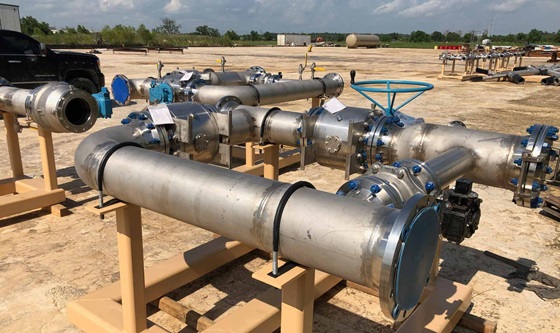
For fabricated pipe spools, our team reviews every order against the project piping class, approved drawings and inspection requirements. Consequently, the quotation and approved documents define the final dimensions, ratings, materials and acceptance criteria. Where applicable, buyers can consult ASME B31.3 Process Piping and the ASTM standards resources alongside the approved project specifications. The table below outlines the available manufacturing scope.
| Size range | Nominal pipe size 1/2 in. to 48 in., subject to material, wall thickness, configuration and handling limits. |
|---|---|
| Wall thickness | Schedule 5 through XXS and project-defined wall thicknesses, subject to size and material availability. |
| Materials | Carbon steel, stainless steel, alloy steel, Inconel, Monel, Hastelloy and other approved materials as specified. |
| Spool components | Straight pipe, elbows, tees, reducers, flanges, branch connections, couplings and agreed attachments. |
| Welding processes | GTAW/TIG, SMAW, GMAW/MIG, FCAW and SAW, selected according to the qualified procedure and production requirement. |
| Applicable standards | Project-specified editions of ASME B31.3 or B31.1, ASME Section IX, ASME B16.5/B16.47 and relevant ASTM material standards, as applicable. |
| Inspection and testing | Visual and dimensional inspection, PMI, PT, MT, RT, UT, hydrostatic or pneumatic testing when specified in the approved inspection plan. |
| Surface treatment | Blasting, painting, coating, pickling and passivation, or project-specified preservation. |
| Documentation | Material certificates, weld map, WPS/PQR and welder records, NDT reports, dimensional reports, test records and release documentation as agreed. |
Procurement note: Send the latest drawing revision, piping class, bill of materials, design conditions, NDT extent, coating specification, documentation requirements and required delivery schedule for an accurate technical and commercial review.
The fabricated pipe spool manufacturing process keeps material identity, dimensional control and inspection status connected to each spool from document review through dispatch.
First, our engineering team reviews approved isometrics, line classes, material requirements, weld details, inspection points and deliverables.
Next, the material-control team checks pipe, fittings and flanges against the bill of materials. The team also maintains identification throughout preparation and fabrication.
Then, technicians measure, cut and bevel components to the approved dimensions. They also allow for weld gaps, orientation and specified end connections.
During fit-up, fabricators control flange orientation, branch position and assembly geometry. Afterwards, welders follow the applicable qualified procedure.
Next, inspectors perform the required visual, dimensional and non-destructive examinations. When the project scope requires it, the testing team also conducts pressure testing.
Finally, the finishing team cleans or coats accepted spools, adds drawing-based tags and protects them for transport. Quality personnel then release the agreed documentation.
Fabricated pipe spools can use several configurations. System layout, transport limits, erection access and the field-joint plan determine each selection. For example, common supply types include:
Explore specific configurations such as flanged pipe spools, elbow spools and removable spools in piping.
Likewise, materials for fabricated pipe spools should follow the piping class, process medium, design temperature, pressure, corrosion allowance and client specification. Mesta Inc. can review requirements for:
Review our dedicated stainless steel pipe spools and steel pipe spool capabilities for material-focused information.
Quality control for fabricated pipe spools begins before cutting. First, the team verifies materials and controls drawing revisions. Then, qualified welding documentation, in-process inspection and final dimensional checks help the team match every spool to the approved project requirements. In addition, the purchaser can specify inspection hold points and third-party inspection.
Material identification and certificates connect the components to each marked spool. As a result, project teams can follow the material record more easily.
Furthermore, weld maps, procedure references, welder identification and examination results support the project documentation package.
Finally, inspectors compare face-to-face dimensions, flange orientation, branch location and overall geometry with the approved drawings.
See our complete approach to pipe spool quality control and testing, including inspection and NDT options.
First, preassembled sections reduce cutting, fit-up and welding activities at congested or elevated installation areas.
As a result, drawing-based dimensions, flange orientation and spool tags help installation teams locate and connect assemblies efficiently.
Moreover, workshop access helps teams coordinate weld examination, dimensional checks, testing and documentation before delivery.
Meanwhile, the workshop can fabricate spools while civil, structural and equipment work continues at the site. This parallel work supports the erection schedule.
In addition, tagged assemblies arrive in installation groups instead of numerous loose pipe lengths, fittings and flanges.
Finally, the project team can align materials, end connections, welding, NDT, coating and document packages with the purchaser's specification.
Industrial teams use fabricated pipe spools wherever they need accurate assembly within a planned shutdown or construction sequence. In particular, typical applications include:
For projects that require coordinated assembly and delivery scope, visit our pipe spool fabrication services and pipe spool assembly pages.
To request fabricated pipe spools, provide a complete enquiry package. This information helps avoid assumptions and shortens technical review time. Include:
A fabricated pipe spool combines pipe with fittings, flanges and other specified components according to an approved drawing. After fabrication, inspectors verify and identify the assembly. The dispatch team then sends it to the installation site for connection.
The terms often overlap. However, “fabricated” emphasizes manufacturing work such as cutting, fitting and welding. In contrast, “prefabricated” emphasizes the workshop location away from the final installation site. Therefore, this page focuses on custom manufacturing, while our prefabricated pipe spools page explains off-site project and installation benefits.
Normally, the fabricator needs an approved piping isometric or detailed spool drawing. The drawing should show dimensions, component specifications, weld joints, flange orientation, branch locations, tolerances, spool number and revision. In addition, send the project specifications and bill of materials.
Common materials include carbon steel, stainless steel and alloy steel. Additionally, the project team may consider nickel alloys such as Inconel, Monel and Hastelloy when the piping class and service conditions require them. During enquiry review, Mesta Inc. confirms material availability and fabrication scope.
Depending on the code and inspection plan, inspectors may perform visual and dimensional checks, positive material identification, liquid penetrant, magnetic particle, radiographic or ultrasonic examination. Moreover, the testing scope may include hydrostatic or pneumatic testing. The project documents must define the exact extent and acceptance criteria.
Each spool can carry a unique number that corresponds to the approved spool drawing or isometric. Consequently, tags, orientation marks, protected flange faces and packing lists help the site team receive, locate and install the correct assembly.
Yes. When the agreed scope includes them, Mesta Inc. can provide surface preparation, painting, coating, pickling, passivation and preservation. Furthermore, the document package can include material certificates, weld records, NDT reports, dimensional reports, test certificates and release documents.
Send Mesta Inc. your drawings, material requirements, quantities, inspection scope and delivery schedule. Our team can review the enquiry and confirm the appropriate fabrication, testing, documentation and dispatch scope for your project.