
Straight Spools
For example, prepared pipe lengths can include butt-weld ends, flanges, couplings or other specified connections.
A steel pipe spool from Mesta Inc. is manufactured to approved drawings, piping classes and project specifications. Therefore, project teams can define the material, dimensions, welding, heat treatment, inspection, surface protection and documentation for each identified assembly.
A steel pipe spool combines pipe with drawing-defined fittings, flanges, branches or attachments as one identified assembly. The fabrication team prepares the assembly before site installation. Consequently, the project can move cutting, fit-up, welding, dimensional inspection and coating into a planned workshop sequence.
The term steel covers several material families. Carbon steels support many general industrial services, while low-alloy and alloy steels address selected temperature, strength or process requirements. However, the project piping material specification must select the exact pipe, fitting, flange, bolting and welding consumable requirements.
Mesta Inc. produces made-to-drawing spool packages for industrial projects. For broader manufacturing information, explore our fabricated pipe spools. In addition, the pipe spool drawing page explains the dimensions, component references and weld data that guide production.
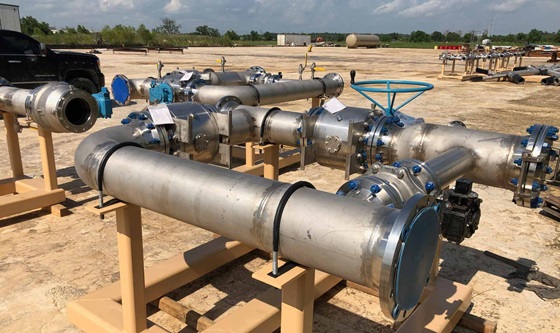
Design conditions should determine the complete steel pipe spool material combination. For example, pressure, minimum and maximum temperature, fluid composition, corrosion allowance, toughness, sour-service requirements and joining methods can influence the selection.
| Material family | Examples often found in specifications | Project items to verify |
|---|---|---|
| Carbon steel | For example, ASTM A106/A106M seamless carbon steel pipe may appear with A234 WPB fittings and A105 forged components. | Grade, manufacturing route, approved standard edition, temperature range, corrosion allowance and impact-test requirements |
| Low-temperature carbon steel | In comparison, specifications may use ASTM A333 pipe, A420 fittings and A350 LF-series forgings where the design basis requires them. | Minimum design temperature, impact-test temperature, grade matching and welding controls |
| Chrome-moly alloy steel | Similarly, selected elevated-temperature services may use ASTM A335 pipe, A234 WP-series fittings and A182 alloy forgings. | Exact P-grade, matching components, preheat, interpass, PWHT, hardness and examination |
| High-strength or project-specific steel | Finally, the project piping class or equipment-package specification may select other approved materials. | Approved product standard, strength, toughness, weldability, heat treatment and traceability |
Material note: The examples above are not interchangeable selections. A qualified piping or materials engineer must approve the complete material class for the actual design code, pressure, temperature, fluid and operating environment.
The approved drawing determines the spool geometry and installation interfaces. Accordingly, steel piping spools can use several configurations within one project.
For example, prepared pipe lengths can include butt-weld ends, flanges, couplings or other specified connections.
In addition, one or more flanges provide bolted interfaces; the drawing must control facing, rating, bore and bolt-hole orientation.
Meanwhile, direction changes combine elbows and straight pipe while maintaining centre-to-face and overall dimensions.
Similarly, concentric or eccentric reducers connect different line sizes according to the required orientation.
Moreover, tees, outlets or fabricated branches introduce additional connections and joint-specific examination requirements.
Finally, defined interfaces connect pumps, vessels, exchangers, skids and other fixed or packaged equipment.
See flanged pipe spools, elbow spools and pipe spool assemblies for configuration-specific information.
Every steel pipe spool order needs a complete and controlled technical basis. Therefore, buyers should state the following information instead of relying on a general steel description. The project must also identify the governing piping code; for example, the official ASME B31.3 Process Piping page describes requirements covering materials, fabrication, examination, inspection and testing for its scope.
| Technical item | Common project options | Information to specify |
|---|---|---|
| Fabrication basis | Approved isometrics, spool drawings, piping class and bill of materials | Document numbers, revisions, design code and client specifications |
| Pipe product | Seamless or welded carbon, low-temperature or alloy steel pipe | ASTM/ASME or other product standard, grade, NPS/DN, schedule and wall |
| Components | Elbows, tees, reducers, flanges, outlets, couplings and attachments | Standard, type, grade, dimensions, rating and quantity |
| End connections | Butt-weld, flanged, socket-weld, threaded or project-specific ends | End preparation, flange facing, class, bore and bolt-hole orientation |
| Welding | GTAW, SMAW, GMAW, FCAW, SAW or approved process combinations | WPS, P-number or material group, consumables, preheat, interpass and heat input |
| Heat treatment | As-welded or project-specified preheat, bake-out and PWHT controls | Applicable joints, temperature cycle, heating method, thermocouples and records |
| Dimensional control | Overall, centre-to-face, face-to-face, flange and branch checks | Critical dimensions, tolerances, datums, hold points and report format |
| Inspection and testing | Visual, dimensional, MT, PT, RT, UT, hardness, PMI or pressure testing | ITP/QAP, examination extent, acceptance criteria and witness points |
| Surface protection | Shop primer, paint system, galvanizing, temporary preservative or bare condition | Preparation grade, coating system, DFT, color, exclusions and repair procedure |
| Documents | Material certificates, weld maps, welding records, NDT reports and release dossier | Document index, certificate type, electronic format and final approval workflow |
Published range: Other current Mesta Inc. spool pages list sizes from 1/2 in to 48 in and Schedule Sch 5 to XXS. However, confirm the available size, wall, material and configuration combination in writing for every steel spool enquiry.
A controlled workflow protects both geometry and weld quality. First, the team reviews drawings, revisions and material status. Next, it prepares and fits each joint against the qualified procedure. Finally, inspection, heat treatment where required and dimensional release confirm the specified condition.
First, identification, certificates and approved substitutions establish the correct pipe and component combination.
Next, controlled preparation establishes length, bevel angle, root face and clean joint surfaces.
Additionally, alignment, root gap, branch orientation and tack quality support the final welding operation.
Therefore, qualified procedures govern processes, consumables, electrical parameters, position and joint-specific requirements.
Furthermore, when specified, temperature controls can reduce hydrogen-cracking risk and support required weld properties.
Lastly, approved cycles, calibrated records and post-treatment examination document compliance where PWHT applies.
For the complete production offer, review our pipe spool services and prefabricated pipe spools.
Engineering note: Preheat, consumables and PWHT depend on the material, thickness, joint, code and service. The approved WPS and project specification must define the actual requirements.
The approved inspection and test plan should connect fabrication activities with examination points and records. As a result, the final dossier can show how the completed spool relates to its materials, welds, dimensions, tests and release status.
First, certificates, heat numbers and PMI when specified can verify the required material identity.
Next, weld maps can connect each joint to the WPS, welder identity, consumable and examination records.
In addition, visual examination and specified MT, PT, RT or UT assess welds against project acceptance criteria.
Furthermore, reports can record overall dimensions, flange alignment, branch location and interface orientation.
Likewise, selected alloy, sour or heat-treated services may require project-defined hardness or production test records.
Finally, when required, approved procedures define test limits, medium, gauges, hold time, safety controls and drainage.
See Quality Control and Testing for the broader inspection workflow.
Carbon and low-alloy steel surfaces generally need project-defined corrosion protection for handling, storage and service. However, the correct system depends on operating temperature, environment, insulation, fireproofing, transport conditions and the final field-coating strategy.
First, specifications may define solvent cleaning, power-tool cleaning, abrasive blasting and a required surface profile.
Next, a compatible primer can provide temporary or system-specific protection before field application.
In addition, multiple coats may require defined products, dry-film thickness, stripe coats, cure times and inspection.
Alternatively, selected services may specify galvanizing after approval of the design, venting, material and dimensional effects.
However, weld bevels, gasket faces, threaded areas, identification and field-weld zones may need masking or temporary protection.
Finally, end caps, flange protectors, supports and suitable packing help preserve cleanliness and coated surfaces.
The RFQ should identify any insulated, buried, immersed, high-temperature or corrosive-atmosphere service so the owner-approved coating specification can address it.
To begin with, send the latest approved project drawings and piping specifications. Also include:
Additionally, identify fixed equipment interfaces and critical dimensions so the technical review can address fit-up risk before production.
A steel pipe spool is a drawing-defined piping section that combines steel pipe with approved fittings, flanges, branches or attachments before site installation.
Projects commonly specify carbon, low-temperature carbon or alloy steels. However, the piping material class must define the exact pipe, fitting, flange and welding-consumable combination.
Carbon steel supports many general industrial duties. In contrast, alloy steels add controlled alloying elements for selected strength, temperature or process requirements and can need stricter welding and heat-treatment controls.
No. PWHT depends on the material, thickness, joint, governing code, service and project specification. Therefore, the approved welding documents must define where it applies.
In addition, an approved quality plan may specify visual inspection, MT, PT, RT, UT or other examinations according to the joint, material and acceptance criteria.
Yes. For example, the approved specification may define surface preparation, coating or galvanizing requirements, exclusions, inspection criteria and repair methods.
Finally, the agreed dossier can include drawings, material certificates, weld maps, welding records, heat-treatment charts, NDT reports, dimensional reports, pressure-test records, coating reports and release documents.
Send Mesta Inc. your approved drawings, material specifications, quantities, welding and heat-treatment requirements, inspection scope, coating system and delivery schedule. Our team will review the manufacturing scope and identify any technical clarification required for quotation.